Dear Person Who Once Knew An Earlier Version of Me 1, 2, 3, 4, 5, 6, 7, 8, 9, or 10+ Years Ago

If still unfamiliar with hermit crab essays, I hope to rectify that with this post.
Even if unaware of the term, I suspect you have come across hermit crab essays before this newsletter post, as it simply refers to any works that convey their message in a form other than the traditional essay with a series of paragraphs. When my first exhibition artwork, University Ableism Bingo, was created in 2020, I had no clue what a hermit crab essay was, but it fit the criteria as it used the container of a bingo card.
Since then, I have had hermit crab essays published in the forms of a poem, a word search puzzle, a recipe, etc. For the sake of this newsletter post, you may have already guessed that I am using the form of a letter to process some conflicted feelings that arose following well-intended communication from someone with whom I last shared a meal a decade ago.
Dear Person Who Once Knew An Earlier Version of Me 1, 2, 3, 4, 5, 6, 7, 8, 9, or 10+ Years Ago...
First of all, if you knew an earlier version of me because you harmed me and opted for avoidance instead of accountability, my last newsletter post likely applies to you much more than this one, so read it.
Also, you might want to take a moment to ask yourself why you are so hellbent on outrunning sense when it comes to me, and journal about it, rather than continuing fuckery!🔥
For the actual intended reader who has not failed me to the best of their knowledge, you need to know that the past decade has been one of what feels like irreparable trauma that has disabled me in ways I continue to process, so I am going to use the 10 Disability Justice principles to make this point, as I want you to make an informed decision about how to proceed.
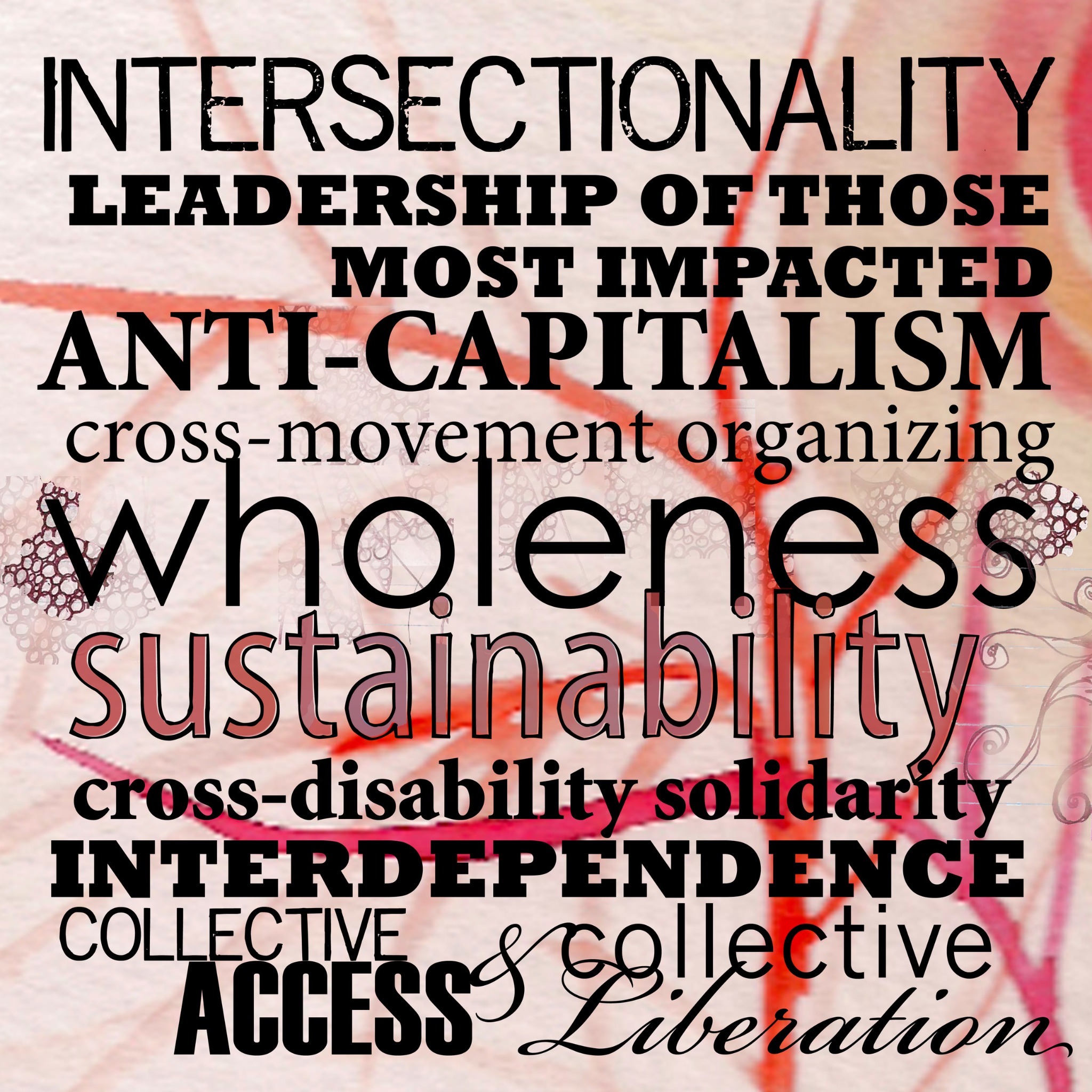
The 1st principle of the Disability Justice framework developed by Sins Invalid in 2005 is Intersectionality, which reminds me that I have always deserved to exist, even when ableism intersects with white supremacy, settler-colonialism, capitalism, xenophobia, queerantagonism, anti-fatness, ageism, etc. to deem me disposable. Unfortunately, many only pay lip service to an understanding of intersectionality, as I know from being constructively dismissed from "an equity office" at Canada's largest university.
The 2nd principle of the Disability Justice framework developed by Sins Invalid is Leadership of Those Most Impacted, which is why I always demand better of myself when I hold relative privilege, but that lens likely made me the easiest of marks for my ex's Access Intimacy Abuse.
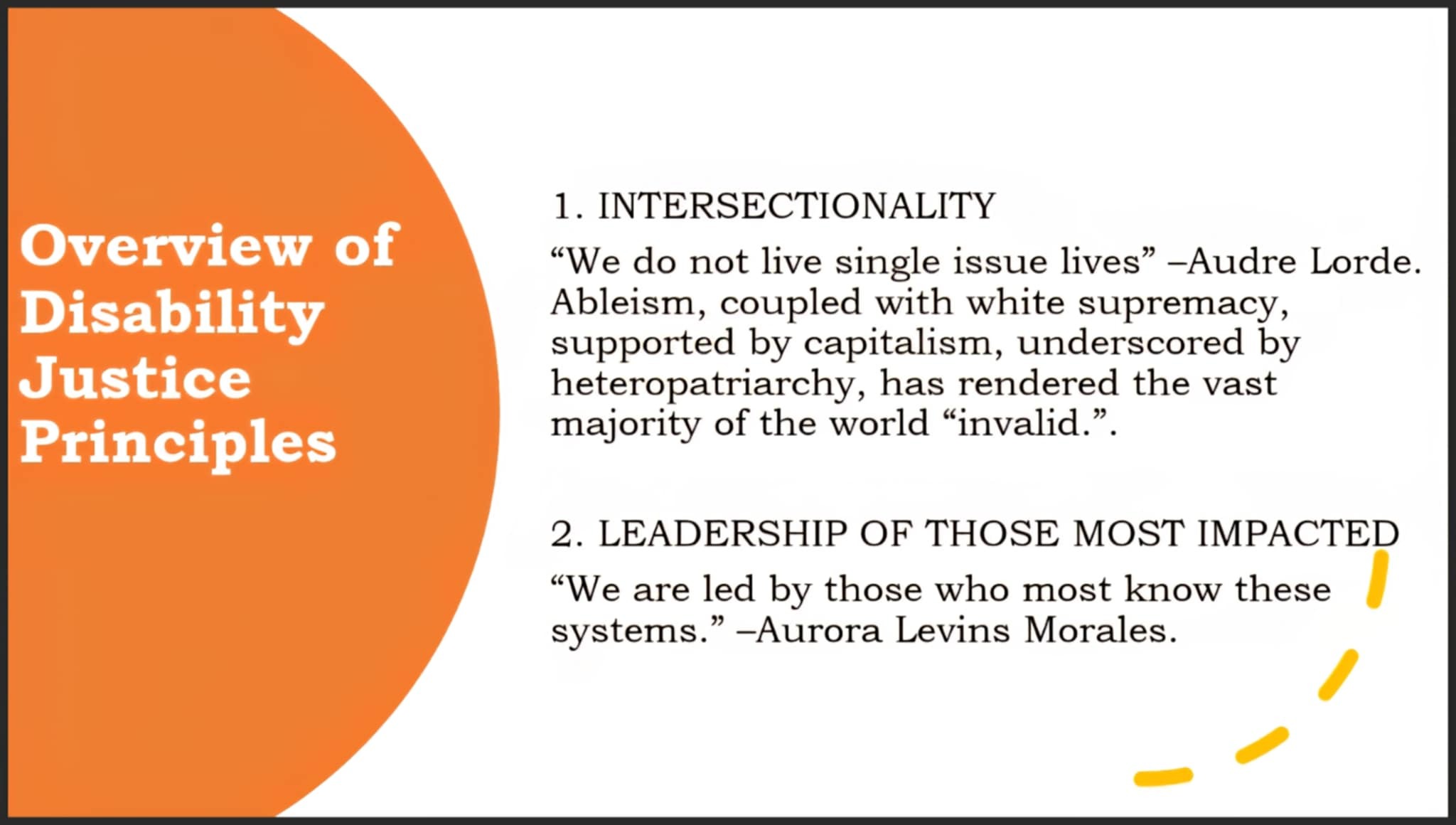
Considering how my ex's financial abuse of at least $183,364 over 6.5 years, combined with white supremacist workplace harassment in both the medical-industrial complex and the academic-industrial complex since 2016, has limited my ability to afford to exist under late-stage capitalism, I am no longer able to code-switch or mask as I once could, which can be challenging to navigate, especially if not keen on thinking critically about one's complicity with my oppression."
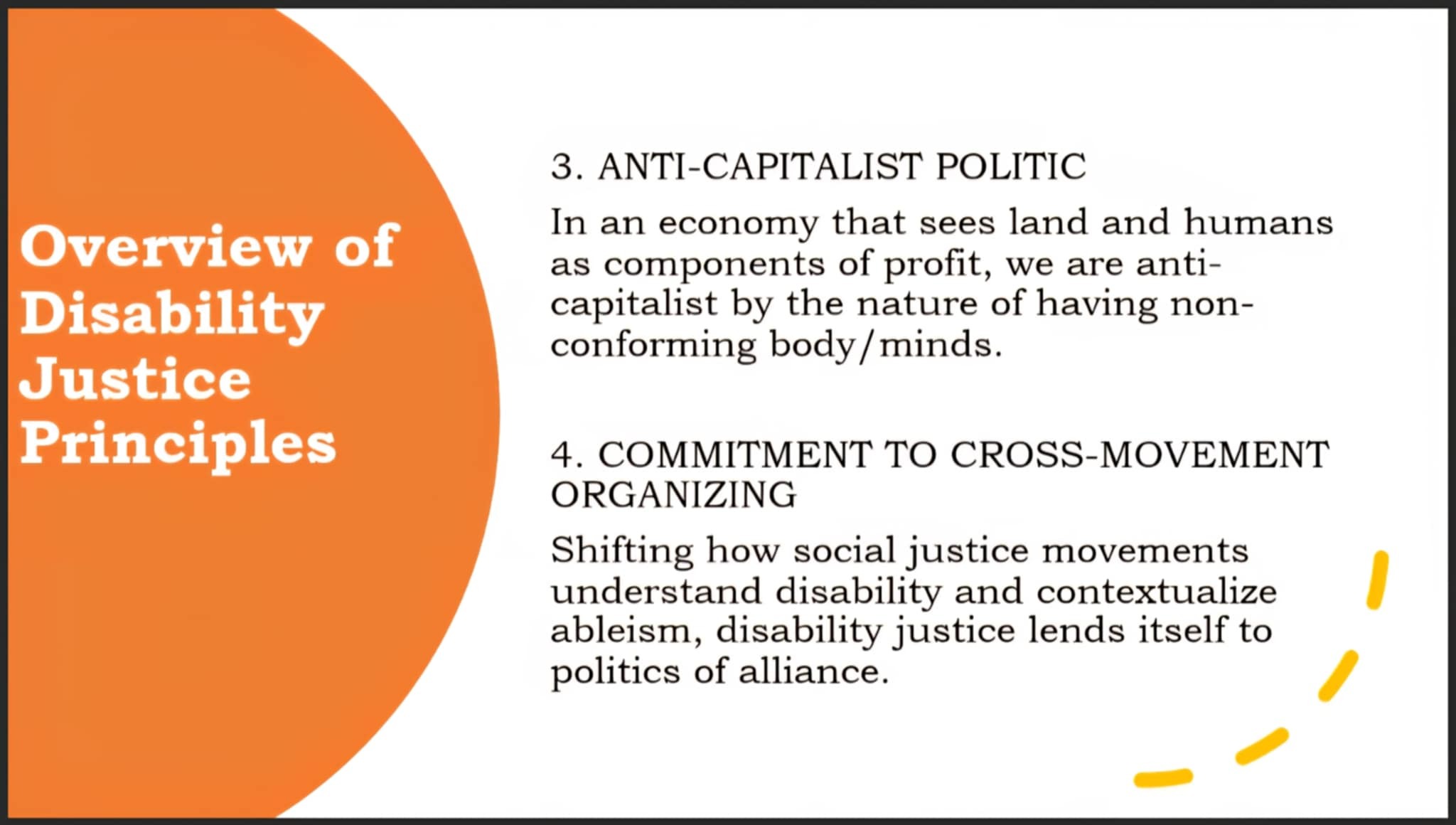
The 3rd principle of the Disability Justice framework developed by Sins Invalid is Anti-capitalism, which has long guided my approach as a Disability Justice practitioner, navigating financial precarity:
The 4th principle of the Disability Justice framework developed by Sins Invalid is Cross-Movement Organizing, which has informed my solidarity with movements like Black Lives Matter, Land Back, Abolition, etc. Unfortunately, my public pro-Palestinian liberation stance has reduced my opportunities for paid work for years, contributing to further financial precarity to the point of depleting most of my retirement savings for survival, which deepened my commitment to Mad Liberation, as I unpack my own madness.
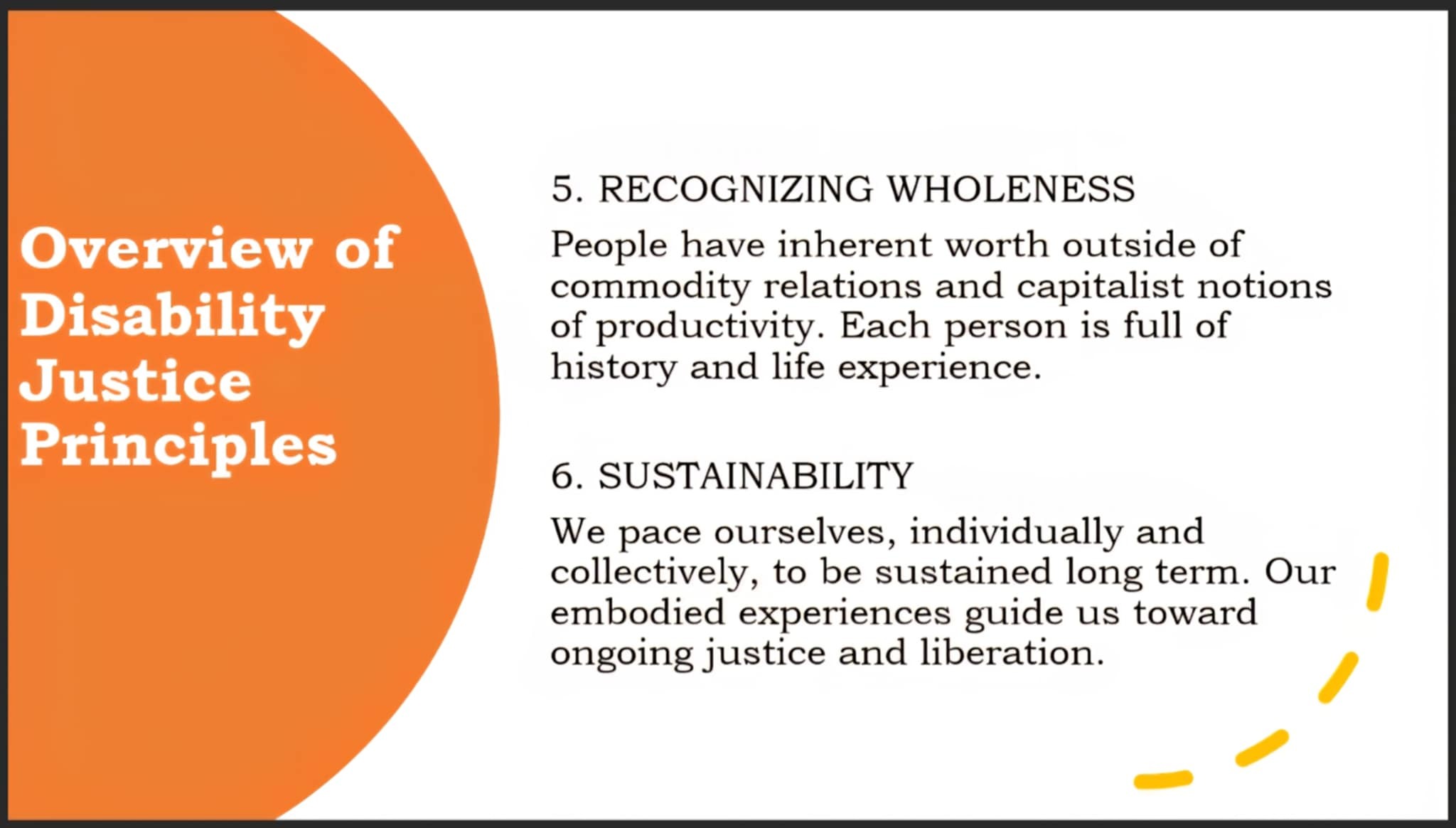
The 5th principle of the Disability Justice framework developed by Sins Invalid is Wholeness, which is what I try to remember that I still am when demoralized over my inability to find sufficient paid work to afford to exist, especially since I have the most lived experience of oppression than ever before to inform my longstanding commitment to Disability Justice work.
The 6th principle of the Disability Justice framework developed by Sins Invalid is Sustainability, which is my priority when I make more intentional decisions about where I devote my few spoons or how to honour my access needs, as I realize in retrospect how my longstanding "social worker, committed to anti-oppressive practice" identity made me the easiest of marks, so I am trying to work towards more reciprocal dynamics, as I cannot afford to waste my limited capacity on futile efforts.
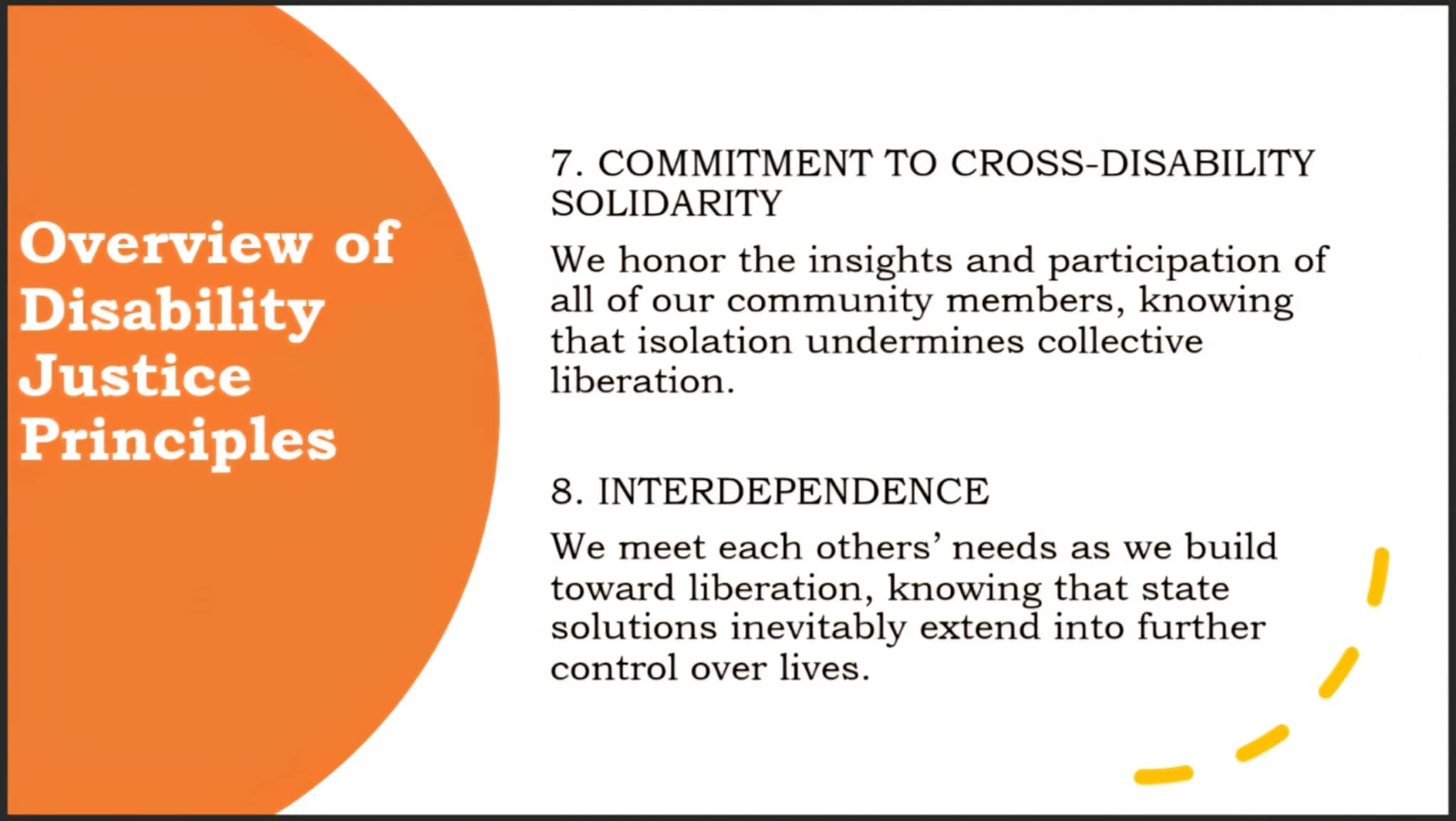
The 7th principle of the Disability Justice framework developed by Sins Invalid is Cross-Disability Solidarity, which means working to support other folx with disabilities that differ from my own individual access needs, which is why I have long advocated for folx to use alt text with their social media posts, as I understand that solidarity is how we ensure that nobody is left behind.
The 8th principle of the Disability Justice framework developed by Sins Invalid is Interdependence, which reminds us that we all rely on others, but only disabled folx are pathologized for needing help, as I continue to address my own internalized ableism so that I am well-suited to support others with their required unlearning, learning, and relearning to prioritize Disability Justice work.
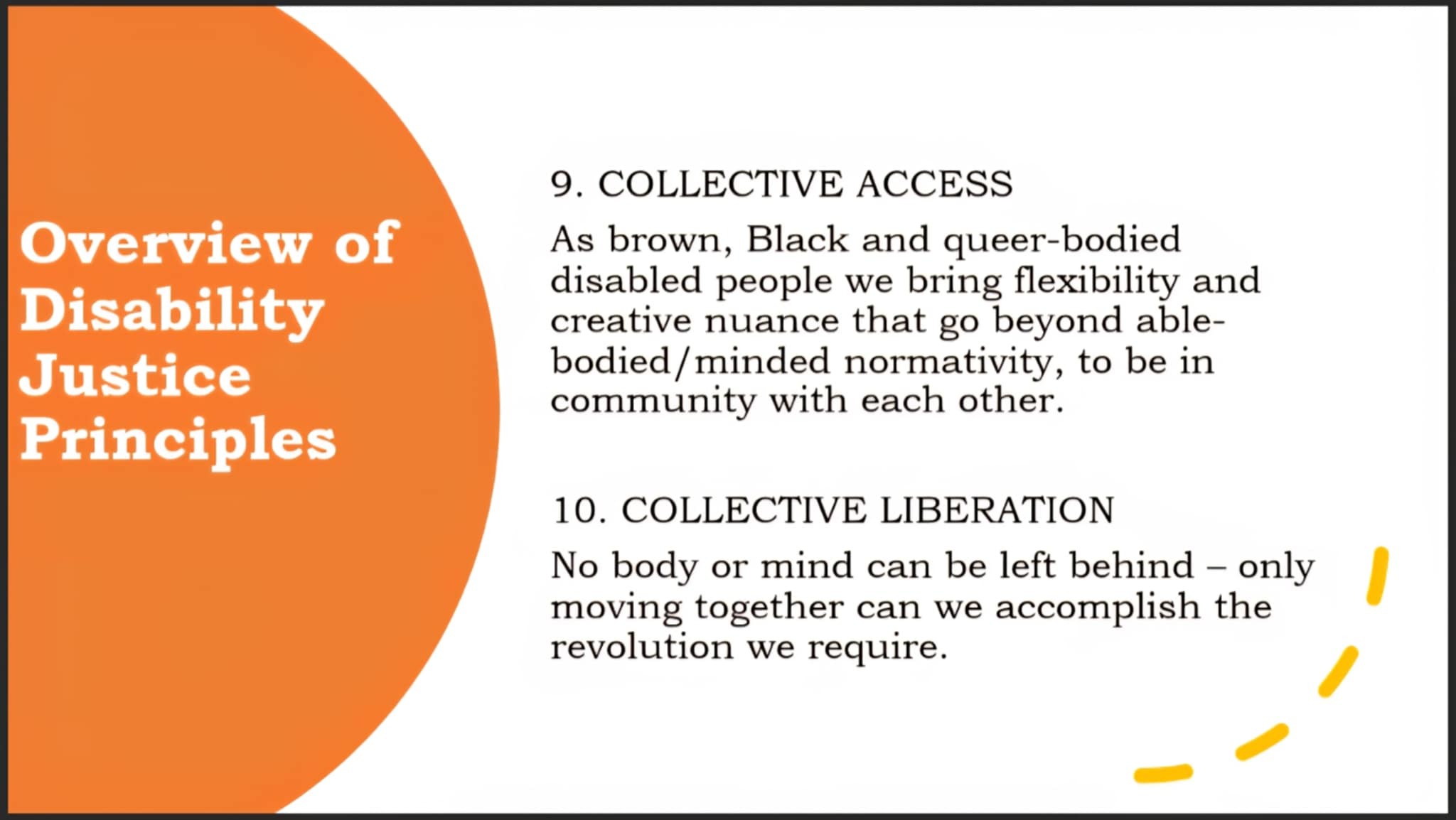
The 9th principle of the Disability Justice framework developed by Sins Invalid is Collective Access, which understands that we do not each ever have equal access at any given time as marginalized groups are often judged for the very barriers oppression places in our path, which can make it difficult to even disclose our access needs when also fat, brown, queer, immigrant, etc.
We all have bodies, hearts, and minds. We all have needs and capacities, strengths and vulnerabilities. A disability justice approach to mixed ability organizing means coming together across difference and inequality to build another, more liberated world. We work with and through the complexities and messiness that inevitably arise in this coming together. We patiently create new practices through dialogue and experimentation, trial and error. A disability justice approach to mixed ability organizing offers new forms of interdependence. We create mutual indebtedness so that nobody is left behind."
The 10th principle of the Disability Justice framework developed by Sins Invalid is Collective Liberation, which no longer feels within reach in my lifetime, but I still invest in Disability Justice work for the sake of my loved ones, as I know how I benefit from the efforts of beloved disabled ancestors like Alice Wong, Patty Berne, Tinu Abayomi-Paul, Stacey Park Milbern, Ki'tay D. Davidson, Ruby Goorahoo, Audre Lorde, Sojourner Truth, Harriet Tubman, etc. whose iconic legacies I only work to exemplify before I join them in the beyond.
For the sake of clarity, I have tried to parse out my reflections of how the last decade of trauma has made this 2026 version of me differ from the 2016 Mental Health Therapist who was served with a disciplinary letter from a white supremacist Executive Director that stated she was "hired to practice social work, not social justice," or the 2021 disabled Accessibility Advisor who was constructively dismissed from "an equity office in name only" at Canada's largest university, but one cannot separate the impacts of each traumatic experience just as one cannot pick and choose some Disability Justice principles while ignoring others without failing to capture the impact of both."
As stated before, this post is most intended for folx who knew an earlier version of me to grasp that the past decade has brought irreparable disabling trauma for me, including white supremacist workplace harassment, gender-based violence (GBV), etc., so one can make an informed decision about engaging (or choosing not to engage) with me further.
However, this is also about conserving my few spoons for more worthwhile efforts than individual implicit emotional labour demands from folx who may not know themselves well enough to avoid hurting me with their uninterrogated propensity for victim blaming, anti-fatness, queerantagonism, classism, xenophobia, ableism, etc."
Had I more capacity, I may not feel the need to write this letter, but Perpetual Perimenopausal Purgatory devours my spoons, which forces me to be more intentional with my limited capacity, as I barely have time to spend with loved ones, so I am working hard to not waste time on folx who may not align with my Disability Justice commitment.
Unfortunately, as discussed earlier, I continue to unpack how my "social worker, committed to anti-oppressive practice" identity for 15 long ass years may have made me the easiest of marks.
Since depleting most of my retirement savings in a desperate attempt to survive Makai Livingstone's Access Intimacy Abuse, workplace trauma in the medical-industrial complex, the academic-industrial complex, etc., I am realizing that earlier approaches to engaging with folx may never have served me well, nor do they remotely serve my access needs.
Although most things remain out of my control, I am actively working on making this decade MINE, even if I fumble through my 40s as I unlearn internalized ableism and learn (and relearn) how to prioritize my access needs."
Over the last decade since first encountering white supremacist workplace harassment that prompted sleep issues and escalated migraines, which would eventually leave me jobless, my definition of success has changed. Then, just as I was trying to reclaim my hard-earned social work career, I met my ex, who would drain me of at least $183,364 over 6.5 years. His financial abuse coincided with my 2nd experience of white supremacist workplace harassment that would leave me jobless, and that debilitating financial precarity resulted in intrusive thoughts, disordered eating, etc., especially given that I remain the firstborn daughter of a gambling addict, so no wonder I am a different version of myself than that naïve registered social worker from 2016. Additionally, COVID-19 never ended for me (along with other disabled folx), but I learnt how many deemed me disposable when they stopped getting vaccinated, masking, etc., which has been demoralizing.
Furthermore, pain is now a daily reality for me between migraines and chronic backache, as has become tears, so the version of me that remains is unlikely to align well with past expectations from before I witnessed Palestinian genocide for 2+ fucking years, while reconciling my ex's betrayal, so I would be lying if I said that I wanted to stay alive as much as before this decade of trauma, which is why I feel the need to warn folx from my past not to expect any earlier versions of me that had to die for me to remotely survive betrayals upon betrayals."
If you have made it to this point, hopefully you can see how this newsletter post uses the form of a letter to demonstrate how hermit crab essays work, while illuminating my deep commitment to Disability Justice over a decade. In case you are the most intended reader for this letter, please take as much time as needed to process what I have shared, and consider (re)reading Leah Lakshmi Piepzna-Samarasinha’s insights about “a fair trade emotional labour economy,” which states, “The thing about being working class or poor…or disabled…or parenting…or Black, Indigenous or brown…[or feminized] is that people are going to ask you to do stuff for them," and PLEASE only follow-up if keen on investing in a fair trade emotional labour economy with me. On the off chance that reading this makes you want to learn more about the Disability Justice movement, I curated a book list to help folx with that.
Depending on when you read this, I may have already resorted to a medically assisted death given my inability to survive Makai Livingstone's Access Intimacy Abuse, so if able to help me avoid that outcome, please do so below.
If able to contribute to my survival following my ex's financial abuse of at least $183,364, which further disabled me, alongside white supremacist workplace trauma, e-transfers within "Canada" may be sent to krystaljagoo@gmail.com and funds may be sent via PayPal below, so please consider supporting me! 🙏🏾
BTW, on the off chance that you are looking for a gifted equity practitioner and educator for virtual services like writing, facilitation, and consulting, you are welcome to peruse my CV below, and explore paid services here.
Post a comment