Reflecting on How the Disability Justice Framework Could Have Benefitted Octavia E. Butler
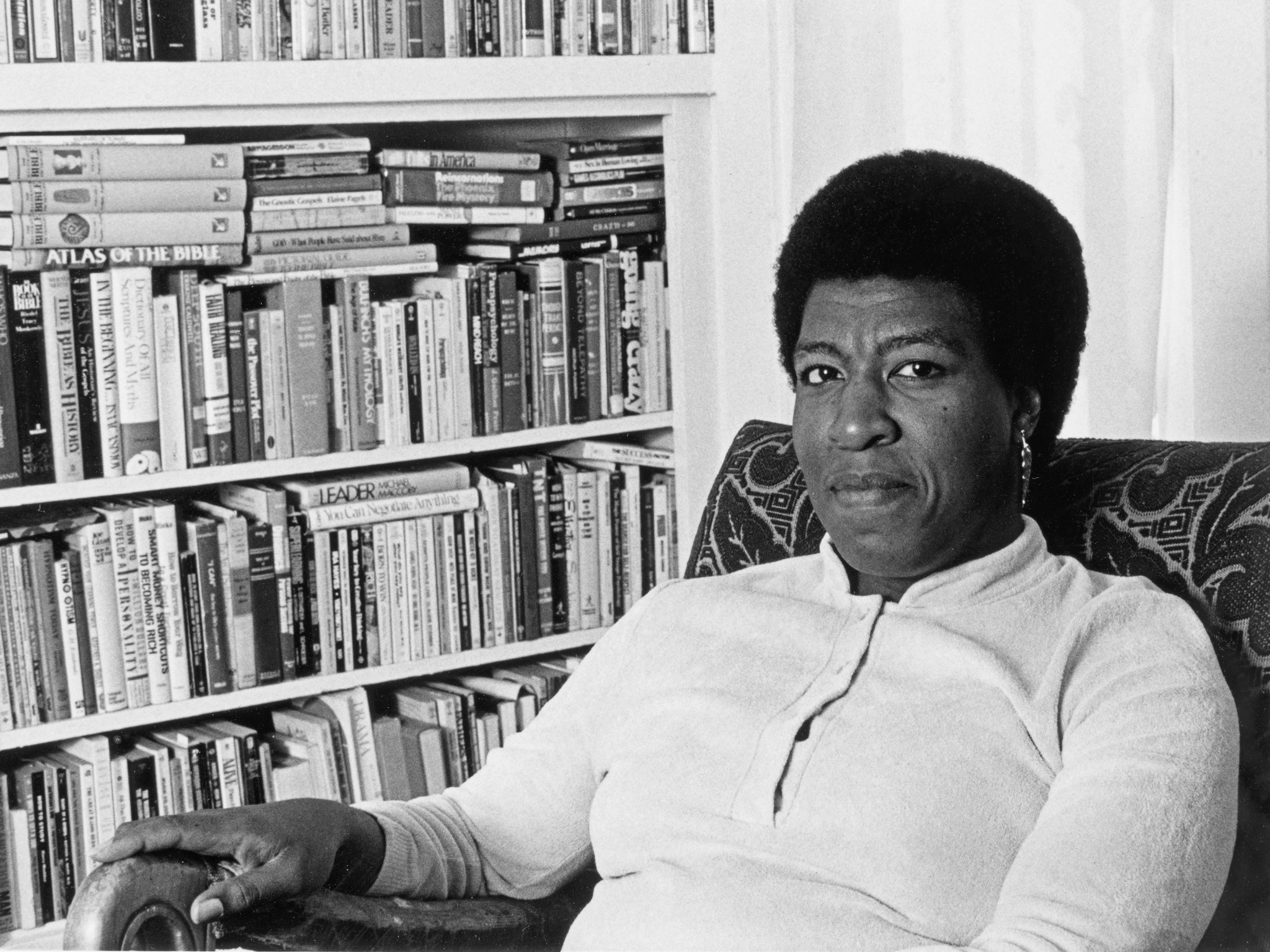
If Octavia E. Butler was still alive, she would have turned 79 this week.
Especially if you have read this newsletter post from last month, reviewed my BIPOC Poetry Gems page, or follow me on Bluesky, you may already know how much I adore Octavia E. Butler's brilliance, but her recent birthday offered a welcome opportunity to consider how her navigation of health issues as a Black woman informed her prolific work, including her 2000 Essence essay:
Just recently I complained to my doctor that the medicine he prescribed had a very annoying side effect.
“I can give you something to counteract that,” my doctor said.
“A medicine to counteract the effects of another medicine?” I asked.
He nodded. “It will be more comfortable for you.”
I began to backpedal. I hate to take medicine. “The problem isn’t that bad.” I said. “I can deal with it.”
“You don’t have to worry,” my doctor said. “This second medication works and there are no side effects.”
That stopped me. It made me absolutely certain that I didn’t want the second medicine. I realized that I didn’t believe there were any medications that had no side effects. In fact, I don’t believe we can do anything at all without side effects–also known as unintended consequences. Those consequences may be beneficial or harmful. They may be too slight to matter or they may be worth the risk because the potential benefits are great, but the consequences are always there."
As some of you know, when struggling to cope with the 2024 election of Trump, I became aware of this relevant passage from Octavia E. Butler's Parable of the Sower book, which offered some comfort amid overwhelming uncertainty:
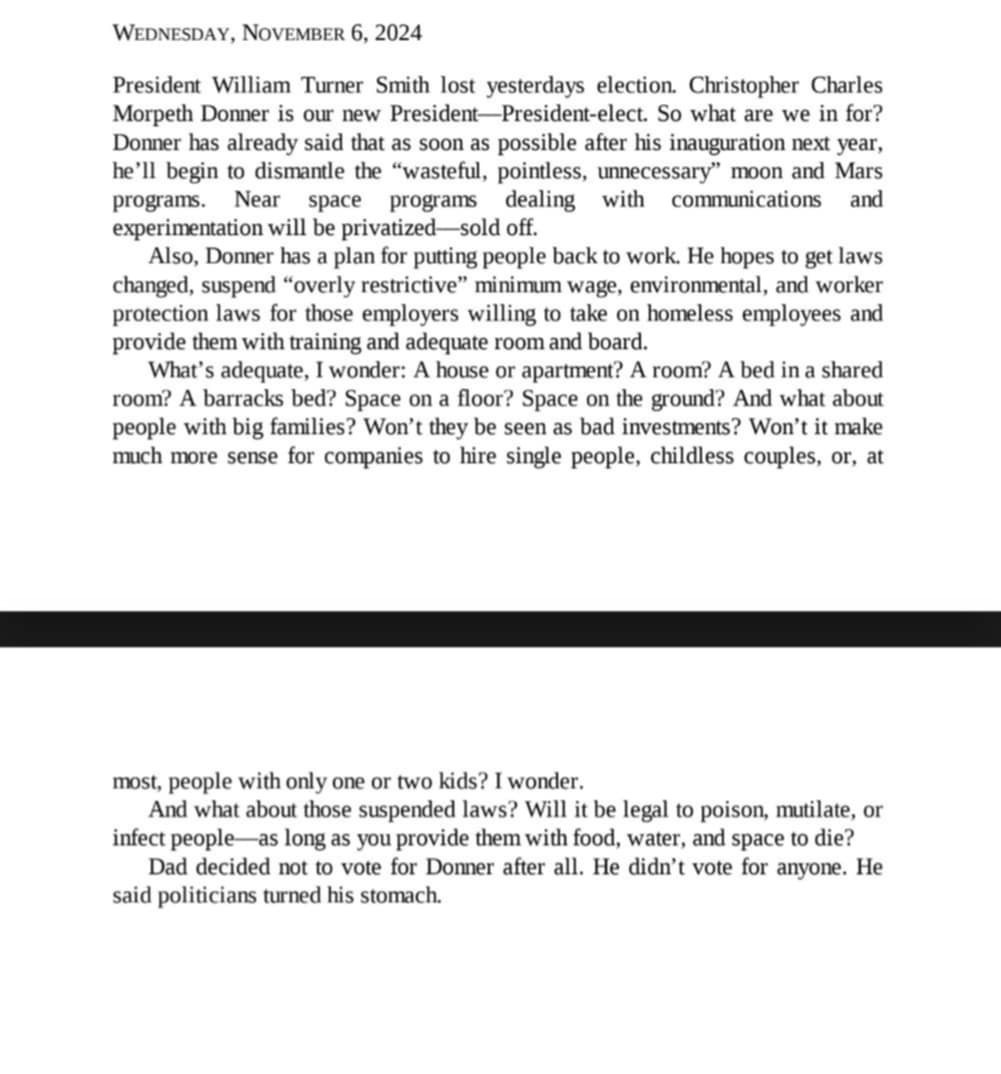
If new to this passage from Octavia E. Butler's novel, you may be tempted to think she could tell the future, but as she discussed in her 2000 Essence essay, if one studies history, one is better equipped to anticipate the future, as she recommends the following:
- Learn from the Past
- Respect the Law of Consequences
- Be Aware of Your Perspective
- Count On the Surprises

Especially if you have already reviewed the recently released report below, you likely know that Trump's 2nd term has already cost the lives of many, and will only continue to do so, based on the recent Protect Our Care press release:
Given how challenging I find it to survive late-stage capitalism in my 40s as a disabled trauma survivor, reading about her life and death at the young age of 58 shed light on the necessity of Disability Justice for Collective Liberation."
Journal entries like these referenced in Dr. Sami Schalk's Octavia E. Butler as an Author of Disability Literature article shed light on how heavily her limited access to medical care weighed on Octavia E. Butler throughout her life:
August 27, 1972.
I hate my present situation. It is physically and mentally debilitating.”
September 11, 1972.
I am stuck. I will have to make firm decisions about how long I will work there and how I will manage to budget in my most pressing problem, my dental work...If the problem were solidly cosmetic, I would live with it the way I have until now. What about my medical problem, if that’s what it is?...I have no idea what a doctor would cost. The only way to find out for sure (as in the case of the dental problem) is to go and be examined. That in itself costs more money than I have.”
November 7, 1972.
Somehow soon—after the next paycheck I have to see a doctor.”
November 12, 1973.
I should stay healthy! The bother and worry of being sick and not being able to afford to do anything but complain about the pain and hope it goes away is Not conducive to good (or prolific) writing.”
June 13, 1993.
I’m barely functioning...I’m not sure what’s wrong with me. I know only that I have scary physical problems and little energy...I hope that’s all. It’s enough.”
June 14, 1994.
I feel worse...Problem with being menopausal is that you can’t tell what should be blamed on the time of life, what on eating a food that disagrees, and what on something completely different...I wish I felt well.”
June 23, 1999.
I’m not writing, not working on the novel, not getting on with the one thing that matters to me. But also, I have pains and too much tiredness...I fear that because I don’t understand what’s going on with my health. Maybe I’m just getting old...I always assumed that getting checked over would put an end to my worries. That was two physicals ago, yet nothing is solved. Here is the thought that haunts me: Maybe I don’t have that much longer to live. Should I, then, spend a year of time I have left moving to another city. And (Or?) if I’m ill and going to need help, ought I to go where such help would be less available?”
July 12, 2000.
If the HBP [high blood pressure] meds are spacing me out, making it harder for me to do the only thing I care about—the thing I’ve spent my life doing, well then they are. I still have to take them.”
May 15, 2001.
I’m taking a medication that flattens out the world for me. It makes sex an exercise in futility and writing an exercise in
frustration...I don’t know what to do, but this is horrible. There has to be an alternative.”
March 13, 2002.
I’m not functioning as well as I should be on any level. I’m not thinking or coping with the daily necessities very well. Why? It isn’t all the medication. That’s part of it, certainly, but that’s not all. The rest is a combination of laziness and giving in—letting the medicine’s effect rule. It’s hard not to, but it isn’t impossible.”
May 26, 2005.
Today I passed out for the first time in my adult life...I’m not at all sure what I hit my head on I suspect it was the office fire extinguisher. I wound up with a lump over my left eye."
Especially if you have read my first guest newsletter post from March in which a Black feminist reckons with anti-Black racism in the medical-industrial complex, you may already see how Octavia E. Butler faced barriers in terms of access to care based on her race, gender, size, class, etc., which likely contributed to her death only 9 months after that 2005 journal entry.
Although Octavia E. Butler may not have embraced a disabled identity, aside from publicly noting dyslexia, these journal entries illuminate how one of the world's most prolific novelists navigated gut wrenching internalized ableism.
Given my own debilitating challenges in the aftermath of white supremacist workplace trauma, gender-based violence (GBV), COVID-19, etc., I am grateful to have encountered these journal entries to remind me of why I do this work.
We all have bodies, hearts, and minds. We all have needs and capacities, strengths and vulnerabilities. A disability justice approach...means coming together across difference and inequality to build another, more liberated world. We work with and through the complexities and messiness that inevitably arise in this coming together. We patiently create new practices through dialogue and experimentation, trial and error. A disability justice approach...offers new forms of interdependence. We create mutual indebtedness so that nobody is left behind."
Depending on when you read this, I may have already resorted to a medically assisted death given my inability to survive Makai Livingstone's Access Intimacy Abuse, so if able to help me avoid that outcome, please do so below.
If able to contribute to my survival following my ex's financial abuse of at least $183,364, which further disabled me, alongside white supremacist workplace trauma, e-transfers within "Canada" may be sent to krystaljagoo@gmail.com and funds may be sent via PayPal below, so please consider supporting me! 🙏🏾
BTW, on the off chance that you are looking for a gifted equity practitioner and educator for virtual services like writing, facilitation, and consulting, you are welcome to peruse my CV below, and explore paid services here.
Post a comment