Academic Ableism Continues, But So Does My Commitment to Doing Disability Justice Work
The good news is that I have seen a new chiropractor. The bad news is that my Chirp Contour has still not arrived (and although this is technically also good news as it will hopefully keep me safe(r) from additional COVID disability-related issues), having received my COVID-19 booster, pain management remains challenging given how shots exacerbate migraines.
As I work towards finally publishing the March post that I have been working on all month, here is a reprint of my 2020 Huffington Post debut essay, which escalated white supremacist workplace harassment at Canada's largest university, resulting in a 5-day suspension without pay by 2021, after which, I would go off on a medical leave, from which, I would never return."
What I’ve Learned About Academic Ableism As A University Employee With Chronic Pain
"My work of challenging my students' internalized ableism has allowed me to gradually accept my own disability."
In my day job as an accessibility adviser at a university, I support students with disabilities to complete their undergraduate studies with academic accommodations. From intake through graduation, if all goes as planned, I work to provide students with extensions and makeup tests when health conditions make these necessary despite their best attempts to avoid that outcome.
While I have yet to see “challenging the inherent ableism in academia” listed in my job description, I understood the need for this work within weeks of liaison with university faculty. It is often why I am told by those in administration that my notes still read as if I’m taking on the role of a therapist — a position I held at the school previously — but one cannot do justice to this work without a thorough understanding of oppression. In fact, it was because of how powerless I often felt when supporting students with individual coping skills for what was often rooted in systemic oppression that I left my job as a therapist.
After 22 months in my current position, I still often feel powerless to help students when faculty are unreceptive to liaison from Accessibility Services, especially when folx in administration fail to see how the body I inhabit has an impact on how I am received.
By the time COVID-19 changed how the institution operated in March, students with disabilities were especially affected. They saw that instructors were taking health concerns seriously, and so many of them shared their frustrations that it took a global pandemic for such a necessary shift in the culture.
Some of them thrived, as anxiety no longer limited attendance to those with the ability to participate via Zoom. Others found it more challenging, as the uncertainty of such an unprecedented time made sleep difficult, escalated panic and limited the concentration needed to complete the winter term. Even more heartbreaking were the stories from East Asian students who also had to contend with racism and xenophobia on top of medical diagnoses, which often exacerbated disability issues.
While some may view the scope of my role as primarily to assess a student’s disability needs and liaison with faculty regarding academic accommodations, I know far better. I know that students respond to commonality between our lived experiences when they feel comfortable sharing how ableism intersects with racism. Those disclosures require an ethical response from a social worker committed to anti-oppressive practice, which means I validate those feelings and take the time necessary to help students move from such distress toward the academic plans referenced in my job description.
I feel powerless to help students when faculty are unreceptive to liaison from Accessibility Services, especially when folx in administration fail to see how the body I inhabit has an impact on how I am received.”
Despite no shortage of reasons why students might experience a flare-up of symptoms at a time when so little felt like it was within their control, I was devastated by how many of them would beat themselves up for not being productive with their plans for writing lengthy papers or studying for final exams. Every day, I would spend hours of my time reminding students that we have no experience surviving a global pandemic, so we should try to be understanding with ourselves if we are struggling more than usual to keep up our productivity levels right now.
I knew all too well that my own ability to concentrate on my work duties had been undeniably affected by my increasing challenges with back pain, sleep and migraines, as well as the accompanying lack of understanding from less equity-minded folx in administration. Following my last day of work on campus in March, I proceeded to visit my chiropractor’s office for my twice-weekly appointment and was told they would be closed for the next three weeks to help flatten the curve of Coronavirus infections. I will admit that in the beginning, I naively thought that quarantine measures would be brief, so I rationalized that it would be nice to not have to commute for two hours daily. As weeks passed, though, I missed no one more than my beloved chiropractor.
Unfortunately, it would be three long months until my chiropractic treatment could resume, during which I dealt with increasingly greater back pain, which limited sleep and exacerbated migraines. Although each of these challenges individually may have been manageable, the unholy trinity together proved debilitating.
Given how benign the description of “soft tissue injuries” sounds, the back pain that has tormented me for decades feels much worse. Meanwhile, sleep issues following workplace harassment in 2016 feel like the ultimate betrayal, as they came after 30 long years during which I had come to expect rest at the end of each day. Migraine disorder was the first to grace my chart in the doctor’s office, and that diagnosis came after I repeatedly complained about my headaches.
Often, I would miss a day or two of work and apologize profusely to students upon my return, in an attempt to challenge their internalized ableism about not working hard enough.”
In the long months before my diagnosis, assumptions that I was just partying too much in university was what passed for care in the medical-industrial complex, as my doctor failed to see the humanity of a young woman from the Caribbean.
I understand the struggles of students with disabilities because I face my own health challenges. During this global pandemic, back pain, migraines and sleep issues converged to wreak havoc on my daily functioning.
At first I hesitated to take sick time, especially when students were writing final exams in late spring. As the weeks went on, the ability to function at work became less and less within my control, so I took more sick days than I had in my prior two years at the university, despite my best efforts.
Often, I would miss a day or two of work and apologize profusely to students upon my return, in an attempt to challenge their internalized ableism about not working hard enough. This was necessary when another extension was needed, or a makeup test had to be facilitated. There was not a shadow of doubt in my mind that such accommodations were necessary due to unavoidable flare-ups.
Unfortunately, employment at three universities in my decadelong career as a social worker had taken its toll, as I knew better than to expect compassion from academia’s altar to ableism. I had grown accustomed to daily violations of my humanity, clothed in condescending language to gaslight, silence, and derail me. Unfortunately, my experience mirrors that of other BIPOC folx — our work is more heavily policed when the unoppressed even deign to let the likes of us into the whiteness of academia. I know this both from countless anecdotes shared between labored breaths and wailing sobs, as well as the research that academia prefers to engage in rather than believe our lived experiences.
A good snapshot of the mindfuck that has been my experience is what I navigated earlier this year, when I simultaneously received a letter from management about concerns regarding my work and was also nominated for an award, based on demonstration of outstanding commitment to service to students.
Over time, I grew more comfortable with using my own pandemic experience of pain issues for appropriate self-disclosure to help students understand that many of us were struggling, especially when quarantine measures reduced access to necessary treatment for our health. As I reflect on this, I realize that the visceral distance from that physical campus space has undoubtedly supported my ability to shake off those ableist confines of academia that bound me.
Turns out, it would take COVID-19 for me to grow more comfortable with accepting my own identity as disabled, despite working hard for decades to challenge internalized ableism with any population I served in various social work roles. Although I cringed when students questioned their worth due to exacerbated disability issues limiting their academic plans, I somehow had less understanding for my own gaps in functioning due to disrupted chiropractic treatment for weeks.
I realize that the visceral distance from that physical campus space has undoubtedly supported my ability to shake off those ableist confines of academia that bound me.”
As my students with disabilities struggled more than usual with executive functioning, which exacerbated their internalized negative beliefs about themselves, my work of challenging those beliefs allowed me to gradually accept my own disability. I worked on unpacking internalized ableism with students when they fell into the trap of thinking that good health was a moral obligation when they were struggling to be productive in academia. It was then that I realized I, too, needed a reminder that disability issues require accommodations for equity, whether they required more sick time or a group work alternative.
Unfortunately, unpacking internalized ableism will continue to be necessary in the current context whereby able-bodied folx largely dictate the terms of reference for what is required. It is why I support students when faculty members question whether an entire week’s extension is needed, even though that’s their academic accommodation based on their disability.
I understand this personally, as my own boss is aware that migraines, sleep issues and back pain are all chronic health conditions that can be aggravated by stress, and he is also aware that medical documentation will be based on my self-report, yet that does not stop his ableist expectations. As I reinforce to students that bureaucratic opposition never invalidates their disabilities, it serves as a good reminder for me as well. I will happily maintain this work of confronting internalized ableism for me and my students, because if the current pushback is any indication, these reminders will continue to be needed.
***Please note that the author is no longer a registered social worker, as of 2025, since losing all respect for the Ontario College of Social Workers and Social Service Workers after they failed to even call for a ceasefire despite witnessing intensified Palestinian genocide throughout 2024. After 15 years, and $4,375 in annual fees she could desperately use in the aftermath of ableist white supremacist workplace harassment, gender-based violence (GBV), etc., her name is no longer followed by "RSW." Nonetheless, she retains 15 years of experience in such roles as Therapist, Sessional Faculty, Accessibility Advisor, etc., which still informs her work as an equity practitioner and educator.***
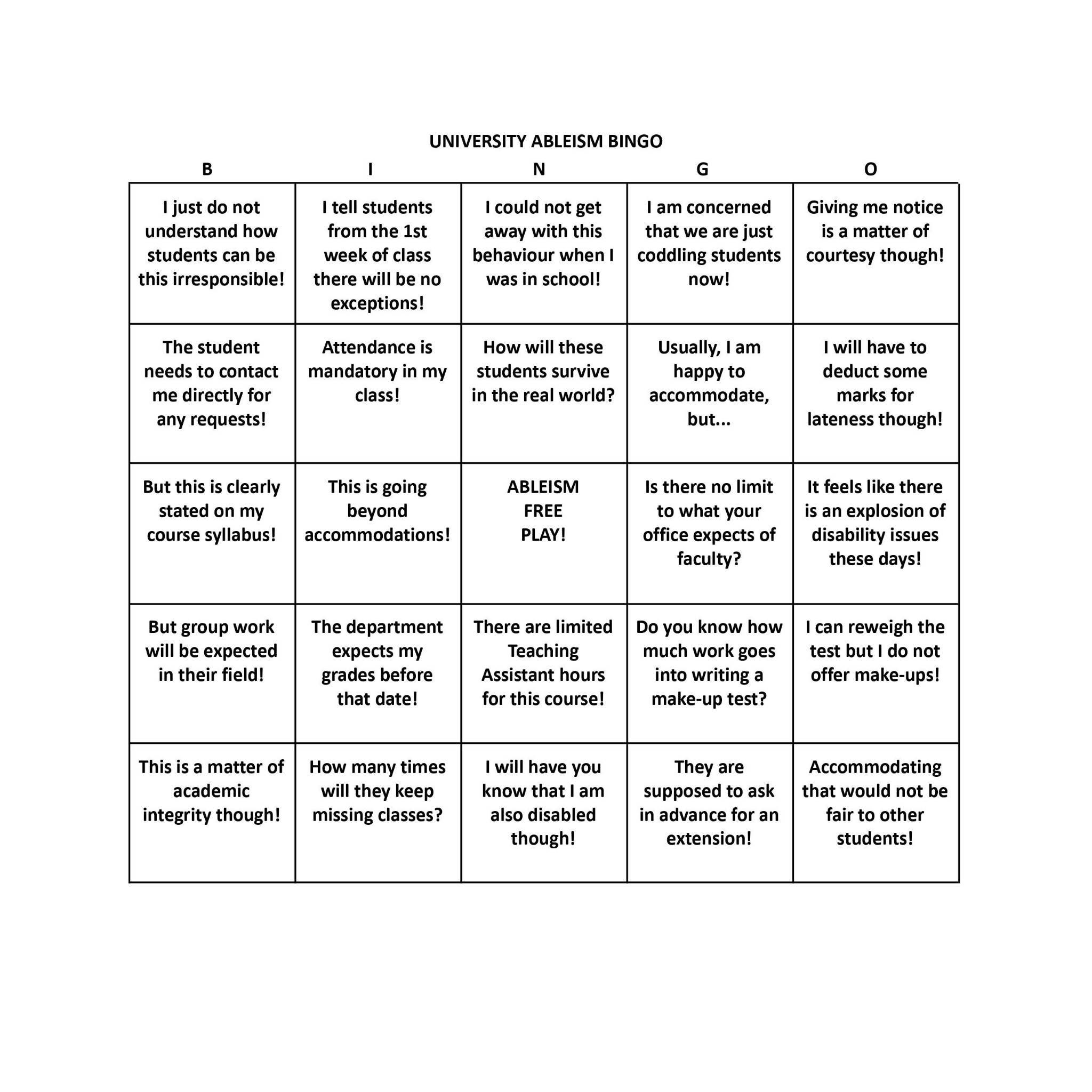
In the years since being chewed up and spit out by what I came to call "an equity office in name only," I have continued to think critically about access, which is why I created an Access Hostility Bingo hermit crab essay in 2023 (while still a registered social worker), in which, each square holds an example of some of the problematic ways in which folx respond to our access needs, as I am no less committed to this crucial work of Disability Justice."

As planned, I facilitated my first Access as Love: Weaving Words for Liberation workshop last month. We connected bell hooks' love ethic with the Disability Justice framework. I remain grateful for the participants who gathered virtually with me, as I look forward to this month's session, which will focus on insights from the late Alice Wong."
While I continue to offer free spots, my monthly Disability Justice workshops are made possible by generous donations from paid Ko-fi subscribers, so please consider supporting my DJ work here, if able to contribute financially.
If new to my virtual spaces, I give registrants the 1st 5 minutes to arrive before starting, but generally continue to let folx in until the end. Usually, materials are emailed at least a day before, should advance access aid with feeling comfortable to participate. Attendees are welcome to engage on their own terms, i.e., with no implicit expectation of being on camera, communicating verbally or in the chat, etc. Around the halfway point, a 15-minute-long break is facilitated, after which participants are invited to explore a writing prompt during designated quiet time of 10-20 minutes, depending on preferences. Once the timer ends, participants are invited to share what they wrote or discuss how the process went for them, based on capacity, comfort, interest, vibes, etc. Throughout the workshop, my approach is consent-based, i.e., folx are encouraged to read slides, share feedback, etc., and only those who volunteer to do so are invited to engage further, as there is no pressure to participate beyond one's capacity.
If able to contribute to my survival following my ex's financial abuse of at least $183,364, which further disabled me, alongside white supremacist workplace trauma, e-transfers within "Canada" may be sent to krystaljagoo@gmail.com and funds may be sent via PayPal below, so please consider supporting me! 🙏🏾
BTW, on the off chance that you are looking for a gifted equity practitioner and educator for virtual services like writing, facilitation, and consulting, you are welcome to peruse my CV below, and explore my services here.
Post a comment