What a Disability Justice Practitioner Learned about Organizing from an Orphan Black Rewatch

If you have not yet watched Orphan Black, you may benefit from reading this post after doing so, but if you are okay with spoilers, like my scaredy cat ass, you are welcome to read my insights before feasting on this epic series!🫂
As you can see from the Season 1 trailer above, it is a show about clones, and it begins as the main character, Sarah Manning happens upon the suicide of another character who shares her face, which leads to some revelations! 👀
Now feels like as good a time as any to mention that Cosima's problematic culturally appropriated hairstyle made me even more uncomfortable during my 2026 rewatch than it did when I initially began watching the show in 2013."
By the end of the 1st episode, Helena is hunting the others, while Sarah plots how to steal the $75,000CAD she finds in Beth Childs' bank account, as Alison and Cosima struggle to keep their coalition going without Beth's expertise! 🥹
Upon rewatching this Orphan Black pilot in 2026, I struggled to imagine how Helena could ever become someone with whom Sarah, Alison, and Cosima would eventually collaborate, which easily applies to organizing.
I chuckled to myself, as I was reminded that Chapter 9 of Mariame Kaba's & Kelly Hayes' 2023 book, Let This Radicalize You: Organizing & the Revolution of Reciprocal Care is literally titled, "Organizing Isn't Matchmaking"!
Upon rewatching Tomas exploit and extract labour from Helena, while feeding her the lie that she was the original, as he villainized the other clones as abominations, I wondered about how the myth of exceptionalism may be used to alienate some of us from working in solidarity with others whose interests actually align well with ours."
For reference, I am relying on this definition of Organizing, which comes from the glossary of Mariame Kaba's & Kelly Hayes' 2023 book, Let This Radicalize You: Organizing & the Revolution of Reciprocal Care, which is currently 40% off.
The process of building collective power as a group and using this power to create positive change in people’s lives and shift existing power relations. Organizing involves building people power, constantly bringing new people into the struggle, challenging systemic injustice and inequity, and giving people who are directly impacted by injustice a sense of their own power and a way to exercise it."
Although the following screenshot comes from a later season, Sarah's words to Mark also applies to the reality of her dynamics with the other clones, as Alison and Cosima had no reason to trust her while she was impersonating Beth Childs, but they had limited options and a great deal at stake, given Cosima's health concerns, Alison's worry about the impact on her family, etc.
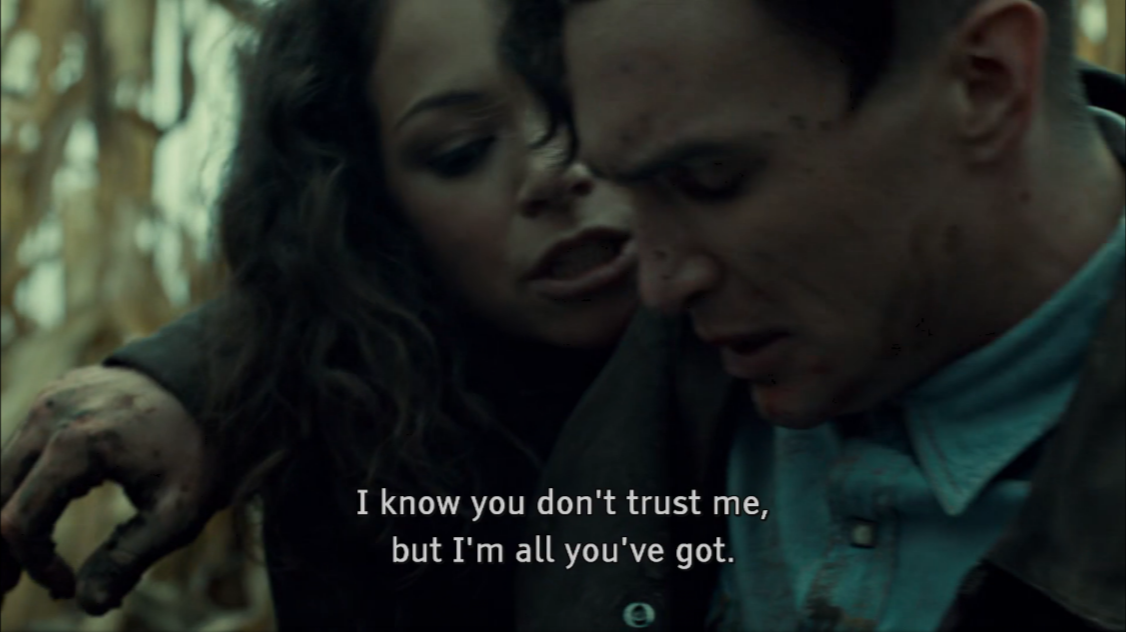
Some groups have learned to navigate difference and animus out of necessity. Incarcerated people organizing within prisons, for example, often learn to put feuds, rivalries, and personal differences aside because they recognize the necessity of building with who is there."
When I initially watched Orphan Black over a decade ago, I had not yet thought of myself as an organizer, as I took quite a while to warm up to it, but being placed on multiple starter packs of organizers on Bluesky has worn me down to accepting such titles despite how they were used to silence me when still employed at the institution that bestowed tenure on Jordan Peterson.
Life-giving organizing in this catastrophic era will require us to chart new political & social maps...Our movements are...practicing & shaping new visions of how we might better relate to one another...Radical organizers are attempting to create something new."
I strongly suspect that many of you have even already done organizing or activism, without necessarily calling it that, so I also wanted to share some of Alice Wong's Disability Justice insights from her ever-relevant 2022 memoir:
Did I dream of becoming an activist? No, but it's probably what I'm most known for. Ableism conscripted me into activism. Other people have the luxury to opt in and out of activism like earning extra credit for a project, but not me. What I have learned about creating change and staying true to myself from childhood up to now is yours for the taking. Getting your needs met, being part of a community, stirring up shit, and sharing information: these are examples of my activism, and there are many ways to be an activist whether you use the word to describe yourself or not. How and where I do it is as important as why and whom I do it with. Being agitated and dissatisfied is an activist mood. Activism is undervalued, unsustainable, and unrelenting. Hypercapitalism, white supremacy, and ableism create the structural conditions that undermine activism and other attempts at changing the status quo. Finding the joy, pleasure, and generative possibilities of organizing is part of my long-term unlearning of what activism is supposed to look like. Unlearning and building anew is activism as well."
Even if you doubt that you have ever participated in organizing or activism, especially as we attempt to survive late-stage capitalism and increasing fascism under the Trump 2.0 regime, I invite you to consider finding any role(s) that resonate(s) from Deepa Iyer's 2020 Social Change Ecosystem Map below, from Caregivers, Disruptors, Healers, Storytellers, Guides, Weavers, Builders, etc:
For instance, it is easy to see how well-suited Felix is to playing the role of Storyteller in how he crafts and shares community stories through his art, but that is not the case for M.K./Veera Suominen, who struggled to get close to any other clones after Ferdinand Chevalier murdered her sister clone, Niki Lintula, but she was an effective Disruptor of Ferdinand's access to 3.7 million Euros.
“We never know how our small activities will affect others through the invisible fabric of our connectedness. In this exquisitely connected world, it's never a question of 'critical mass.' It's always about critical connections.”
I encourage you to consider a single critical connection in your personal life that you could invest in or further strengthen in the near future towards a tiny activity that could support disabled folx and other marginalized groups.
I recently attended a virtual event in which Mariame Kaba encouraged the participants to think as small as their block when attempting to make a difference, especially if new to organizing, activism, collective care, etc.
Throughout the Orphan Black series, we see examples of the clones helping one another with their respective resources and skills, like Alison contributing $75,000CAD to the cause, while Cosima utilized her skills as a researcher.
Are we making sure that every role has multiple people in that role? How do we create more of our work in teams? Relief teams and mechanisms can be created...around particular organizing tasks or roles, or...when an organizer...needs help with...life tasks, like cooking...or picking up groceries."
Like Alice Wong, many of us have been conscripted into organizing and activism based on the debilitating ableism that forces us to barter our humanity in a dumpster-fire society that deems us disposable, but all folx will grow more disabled upon aging til death, so the Disability Justice framework is worth investing in, if only for one's need for accommodations in the future! 👀
Especially if we grasp that each and every person is either already disabled or pre-disabled, we would understand how crucial it is to process the grief that can accompany our loss of abilities as we age until our eventual deaths.
As a longstanding intersectional feminist with an undergraduate degree in Sociology, wherein I first resonated with the concept of the sociological imagination, I have often stated, "the personal is always political," as it reflects my values, but I have survived many who only express those sentiments without ever actually embodying those values."
The Disability Justice framework highlights the need for mixed ability organizing, as we understand that disabled folx need others with relative privilege to work in solidarity with us if we are to achieve Collective Liberation.
A disability justice approach to mixed ability organizing means coming together across difference and inequality to build another, more liberated world. We work with and through the complexities and messiness that inevitably arise in this coming together. We patiently create new practices through dialogue and experimentation, trial and error. A disability justice approach to mixed ability organizing offers new forms of interdependence. We create mutual indebtedness so that nobody is left behind."
It took me a while to warm up to Mrs. Siobhan Sandler, especially since she sacrificed Helena early on! By the final season though, she used her organizing skills to prioritize the interests of ALL the clones, including a secret alliance with Delphine Cormier and Ferdinand Chevalier to free her granddaughter, which would unfortunately then result in her death at Ferdinand's filthy hands.
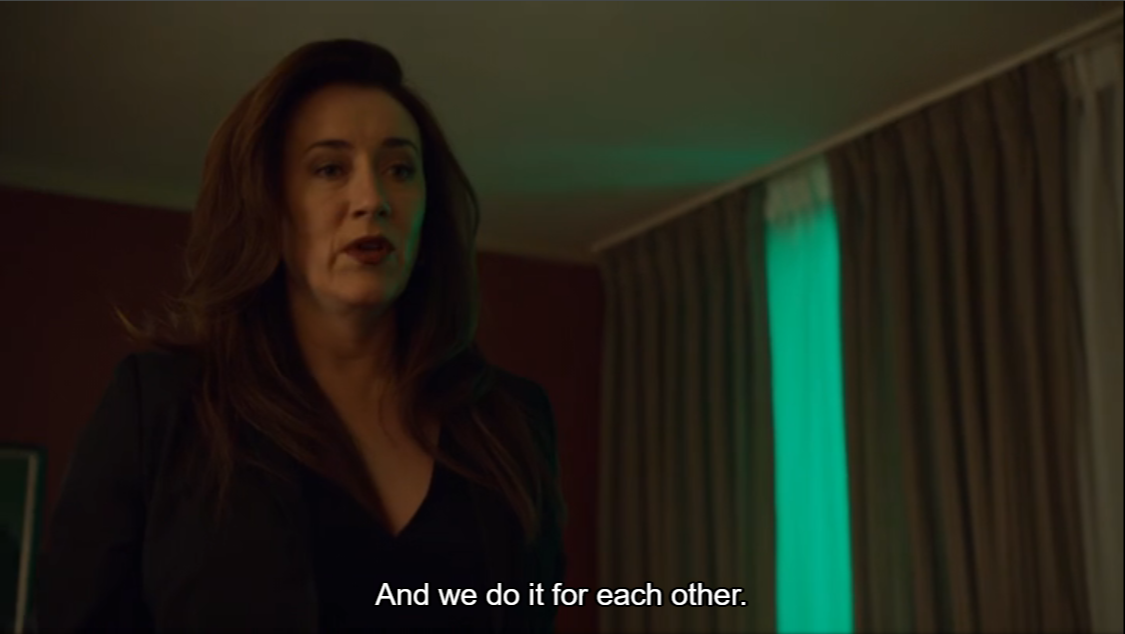
"We do what we can. Each of us in our own way. And we do it for each other."
Having been undone by Mrs. S(iobhan Sandler)'s sacrifice, I was a puddle of tears by the time she returned in flashbacks from Sarah's delivery of Kira, while Sarah and Art supported Helena's delivery of twins in the bleakest situation! 😭
That scene felt like a tangible example of how organizing skills can be passed down as intergenerational wisdom when aligned together for each other's survival. Until reading this 2021 article, The Co-option of Mutual Aid by Regan de Loggans, I had not realized that although Dindial Goorahoo, the late beloved grandfather who raised me in Trinidad, never used the words "mutual aid" a single time until his passing when I was 9 years old, that is exactly what he did when he went back to his family's village after fishing all day to distribute seafood to relatives who likely could not afford fresh fish otherwise. Although Pappy passed away decades ago, I continue to rely on such wisdom in my practice of Disability Justice, as I have not been in a position to do mutual aid with funds for years, but I often share various skills as mutual aid.
Grief work, healing work, & conflict resolution have always been important to our movements, but in this age of catastrophe they are more crucial than ever. A strong organizing community is more than a labor force for social justice. It is an ecosystem of care,...relationship building, & action."
As first discussed in this Remembering Poet, Renée Nicole Good newsletter, I have regularly returned to discussions regarding grief, like with this Disability Justice Work Must Include Holding Space for Grief newsletter, this Trying to Lean Into Disabled Joy, Alongside Grief Galore newsletter, etc, as I firmly believe that is essential for our Collective Access and Collective Liberation.
If we believe having a practice of hope and...grief are important..., we should be creating spaces...for this work...We must ask ourselves, Are we making space for grief in our organizing...? Are we talking about the practice of hope, and how we can orient ourselves in these daunting times?"
By the Orphan Black finale, we see a clandestine meeting between Felix and Rachel, who hands him an envelope, which contains a list of all 274 clones, with all the logistics needed to find and treat them, before Rachel moves on.
We have learned that letting go can be a beautiful thing. Honoring what a group...has accomplished and what it has meant to us while preserving its history and,...carrying its lessons forward, can be an emotional process, but not everything in organizing is about fighting tooth and nail."
As Cosima remarks, "They’re never going to have to go through everything we did,” I am reminded of why we often get into organizing, activism, mutual aid, or whatever we call it when we build collective power to challenge injustice.
1. Organizing Is the Antidote to Despair
2. Collective Liberation Necessitates Collective Care
3. We Need Each Other
...A compass for a life in rehearsal. The rest is up to us, together.
Community organizing requires us to move beyond our own circles to bring in & work alongside those who may not share our life experience or analysis. This is not a simple call for unity; rather, it is working despite & through difference...“make connections, not comparisons.”
Organizing is...transformative: it...transforms dominant systems of power, it transforms our imaginations in prefiguring a future beyond our present...apocalyptic deathscape, it transforms...collective processes by nurturing relationality, & it transforms us...as we realize...capacities.
Organizing thus not only changes the material and social conditions around us; it also changes us in the process. Collective work also encourages abundant leadership. Abundant leadership is about sharing space and power, as opposed to capitalist competition over space and power."
If my reflections about organizing from rewatching Orphan Black in 2026 resonate, you may also benefit from exploring the free Padlet I made with 700+ quotes from the 2023 book, Let This Radicalize You: Organizing & the Revolution of Reciprocal Care, by Mariame Kaba and Kelly Hayes, as a more accessible resource for folx who may find an entire book harder to confront:
By the time this post is published, I am desperately close to being unhoused, so if you can help me avoid a medically assisted death given my inability to survive Makai Livingstone's Access Intimacy Abuse, please do so below.
If able to contribute to my survival following my ex's financial abuse of at least $183,364, which further disabled me, alongside white supremacist workplace trauma, e-transfers within "Canada" may be sent to krystaljagoo@gmail.com and funds may be sent via PayPal below, so please consider supporting me!🙏🏾
BTW, on the off chance that you are looking for a gifted equity practitioner and educator for virtual services like writing, facilitation, and consulting, you are welcome to peruse my CV below, and explore paid services here.
Please consider sharing this newsletter to amplify the reach of my work!🙏🏾
Post a comment