On Audre Lorde's Birthday, I Am Practicing Honouring My Access Needs
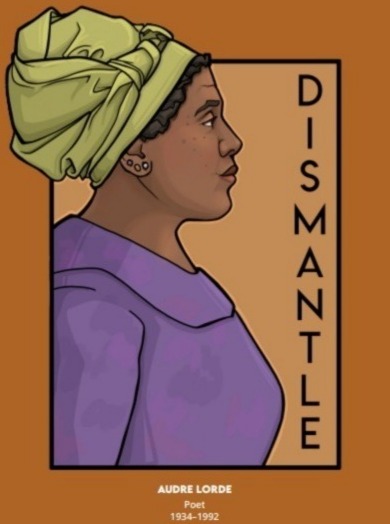
If you have read about how my beloved chiropractor since 2018 retired, it may come as no surprise that I have been surviving increased back pain since. I was struggling to accept that I may be too out of commission to maintain my weekly posts since relaunching my LURNN Newsletter on December 24, 2025 (which you are welcome to support on Ko-fi here, if able), when I saw a Bluesky post about how today is Audre Lorde's birthday.
Caring for myself is not self-indulgence, it is self-preservation, and that is an act of political warfare.”
Depending on how new you are to my work, you may be unaware that having my Audre Lorde essay published in a hard cover anthology I could gift my Black niece remains one of my life's greatest honours, as I consider Audre Lorde part of my disabled lineage, like Alice Wong, Patty Berne, Tinu Abayomi-Paul, Shafiqah Hudson, Stacey Park Milbern, Ki'tay D. Davidson, Ruby Goorahoo, Sojourner Truth, Harriet Tubman, etc. whose DJ work informs mine.
For the master’s tools will never dismantle the master’s house. They may allow us to temporarily beat him at his own game, but they will never enable us to bring about genuine change. Racism and homophobia are real conditions of all our lives in this place and time. I urge each one of us here to reach down into that deep place of knowledge inside herself and touch that terror and loathing of any difference that lives here. See whose face it wears. Then the personal as the political can begin to illuminate all our choices."
In honour of her powerful legacy, I am choosing to care for myself in ways that limit my ability to write a lengthy newsletter post this week, so instead I will share my essay about Audre Lorde, as published in the She Series anthology in 2023:
DISMANTLE: to take apart; to disassemble; to put an end to in a gradual systematic way"
Self-described as a “Black, lesbian, mother, warrior, poet,” Audre Lorde did things on her terms.
She spent her life dismantling systems of oppression with her writing, but even in childhood, she practiced this work, deconstructing the identity given to her at birth by dropping the “y” from her first name, Audrey.
Lorde was born in New York City to Caribbean immigrant parents. Growing up, she was near-sighted to the extent of being considered legally blind and struggled to communicate. Drawn to poetry as a way to express herself, Audre would memorize and recite poems to express her thoughts and feelings.
She began writing her own poems at the age of 12 and was first published while still in high school. After a faculty member deemed a sonnet Audre had written about love “inappropriate” for the school magazine that the young poet edited, Lorde submitted her composition to Seventeen magazine where it was published instead.
Audre graduated from Hunter College in New York, and earned her master’s degree in library science from Columbia University. She worked as a librarian and was a writer-in-residence, teaching young Black students at Tougaloo College in Mississippi, before publishing her first book of poetry, The First Cities, in 1968.
Lorde would go on to publish 18 books in total, including poetry, essay collections, and novels. With her book Zami: A New Spelling of My Name, she even created an entirely new genre of literature—biomythography—which combines history, biography, and myth.
Throughout her life, Audre worked as a writer, poet, feminist, activist, and educator—teaching at Lehman College, John Jay College of Criminal Justice (where she fought to create a Black Studies department), Hunter College, and overseas at the Free University of Berlin.
She co-founded the first American publisher for women of color, Kitchen Table: Women of Color Press, and later co-founded the Women’s Coalition of St. Croix, an organization that helps women heal from gender-based violence. In
1991, she became the New York State Poet Laureate, a role she held—while battling cancer for the second time in her life—until her death the following year.
And all the while, Lorde dismantled barriers and expectations.
She chronicled her journey surviving breast cancer and a mastectomy in The Cancer Journals, published in 1980. Through a combination of journal entries and essays, Audre highlights how the medical system reinforces sexist expectations of women, and reflects on the need for women to have greater autonomy in navigating the treatment options that best fit their circumstances.
Audre’s defiance of norms decades ago regarding societal expectations based on race, gender, ability, and sexuality continues to provide meaningful insights for me personally as I navigate a social work career in which women of color are still harmed by white supremacy, misogyny, homophobia, and ableism. I often find it soul-crushing as a racialized queer woman who speaks and writes truth to power in a university setting, so I can only imagine how much more challenging it must have been for Audre to navigate academia in the second half of the 20th century as a Black lesbian whose work challenged power structures.
But as the poet once stated, “Anger is an appropriate reaction to racist attitudes, as is fury when the actions arising from those attitudes do not change.”
Audre Lorde demonstrated how to harness one’s righteous anger, write about it, amplify it out to the world, and put it to work to bring necessary change.
Near the end of her life, Audre once again changed her name during an African naming ceremony, taking on the name Gamba Adisa, which means “Warrior: She Who Makes Her Meaning Known.”
May we all be inspired by this great warrior poet to dismantle whatever we face that needs to be undone.
Just as I was about to email this newsletter post to my subscribers, I was reminded that today is also Toni Morrison's birthday, so I would be remiss if I did not note that, given how much her writing has undeniably influenced my own work:
Happy Toni Morrison’s birthday to all those who celebrate!
— Saeed Jones (@theferocity.bsky.social) February 18, 2026 at 10:12 AM
For me, success is not a public thing. It's a private thing. It's when you have fewer and fewer regrets.”
If you missed my free/donations-welcome Disability Justice 101 session last month, you are still welcome to join us for the launch of my next free/ donations-welcome workshop, Access is Love: Weaving Words for Liberation, for which, we will focus on bell hooks' love ethic, as scheduled for 7-9pm EST on Saturday, February 28, 2026, in honour of beloved disabled ancestors like Alice Wong, Patty Berne, Tinu Abayomi-Paul, Shafiqah Hudson, Stacey Park Milbern, Ki'tay D. Davidson, Ruby Goorahoo, Audre Lorde, Sojourner Truth, Harriet Tubman, etc. whose crucial DJ work still inform mine.
This February session will be framed around bell hooks' All About Love: New Visions, which can be viewed as a free PDF here, because after this author's ex drains her of $183,364+ to the point of where she is so disabled from his gender-based violence and repeated white supremacist workplace trauma that she is considering a medically assisted death, she has to return to the basics to ensure that she does her best to warn her beloved BIPOC LGBTQIA+ disabled communities how she only wishes his earlier victims had warned her.
While you are welcome to read the entire book, please know that both bell hooks' experts and those who are only newcomers to her brilliance are equally welcome at the session, as I can write an entire set of encyclopedia about men who I never even had reason to take to Red Lobster, whose statements about love proved as believable as Donald Trump deserving a peace prize! 🤡
While I continue to offer free spots, my monthly Disability Justice workshops are made possible by generous donations from paid Ko-fi subscribers, so please consider supporting my DJ work here, if able to contribute financially.
If new to my virtual spaces, I give registrants the 1st 5 minutes to arrive before starting, but generally continue to let folx in until the end. Usually, materials are emailed at least a day before, should advance access aid with feeling comfortable to participate. Attendees are welcome to engage on their own terms, i.e., with no implicit expectation of being on camera, communicating verbally or in the chat, etc. Around the halfway point, a 15-minute-long break is facilitated, after which participants are invited to explore a writing prompt during designated quiet time of 10-20 minutes, depending on preferences. Once the timer ends, participants are invited to share what they wrote or discuss how the process went for them, based on capacity, comfort, interest, vibes, etc. Throughout the workshop, my approach is consent-based, i.e., folx are encouraged to read slides, share feedback, etc., and only those who volunteer to do so are invited to engage further, as there is no pressure to participate beyond one's capacity.
If able to contribute to my survival following my ex's financial abuse of at least $183,364, which further disabled me, alongside white supremacist workplace trauma, e-transfers within "Canada" may be sent to krystaljagoo@gmail.com and funds may be sent via PayPal below, so please consider supporting me! 🙏🏾
BTW, on the off chance that you are looking for a gifted equity practitioner and educator for virtual services like writing, facilitation, and consulting, you are welcome to peruse my CV below, and explore my services here.
Post a comment